Vienna history reads like a novel spanning two millennia — from a Roman frontier garrison to the seat of an empire that shaped Europe, through devastating wars and remarkable reinventions, to the vibrant, forward-looking capital you’ll discover today. Understanding Vienna’s past doesn’t just enrich your visit — it transforms it. Every palace, church, and street corner in this city tells a story, and knowing those stories turns sightseeing into time travel.
This guide traces Vienna’s history through its architecture, connecting the buildings you’ll visit to the people and events that created them. From Roman ruins beneath the city streets to Zaha Hadid’s bold contemporary designs, Vienna’s built environment is a living textbook of European civilization — and one of the most beautiful architectural collections on Earth.
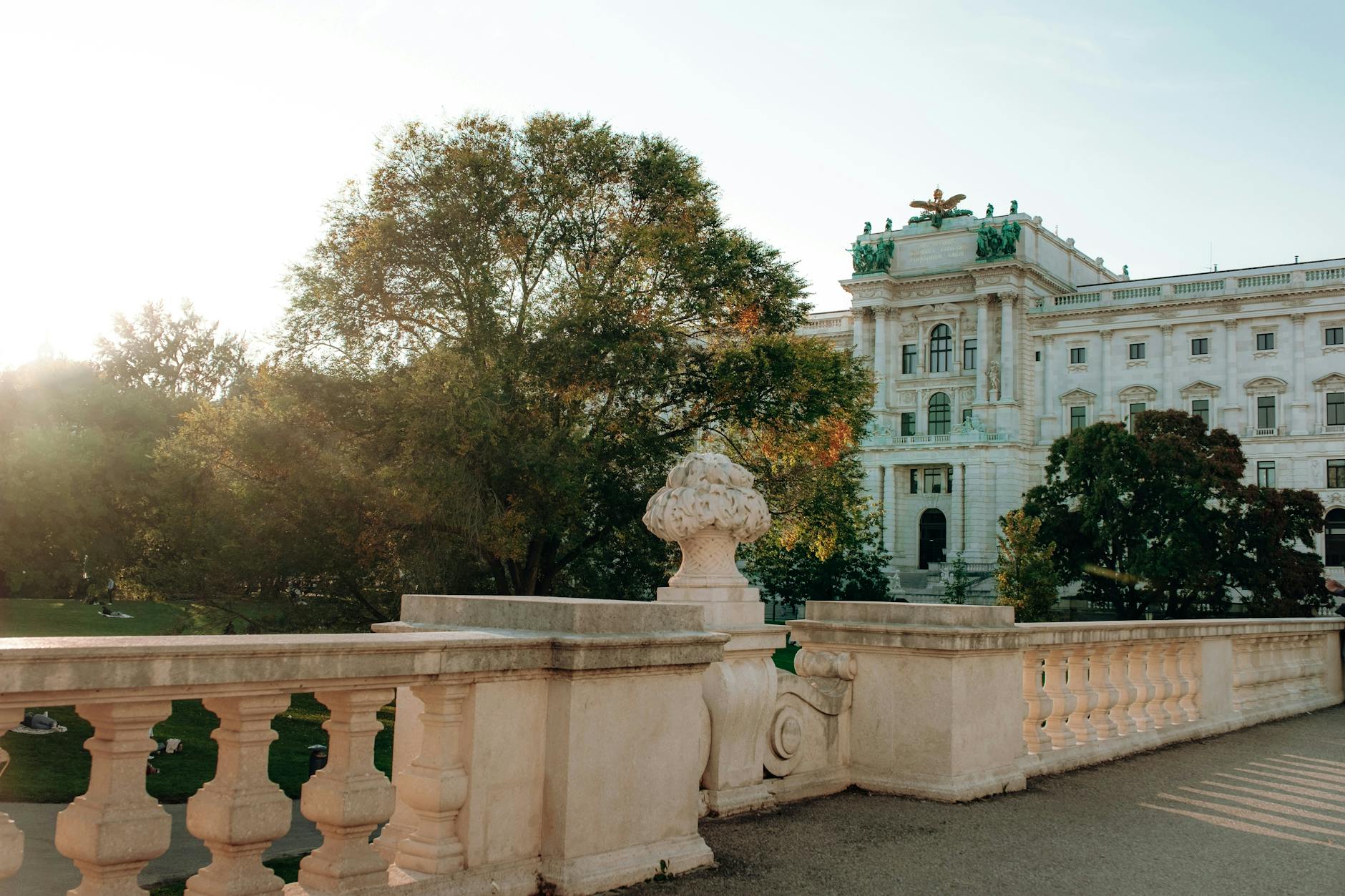
Roman Vindobona: Where Vienna Began (1st–5th Century)
Vienna’s story begins around 15 BC, when the Roman Empire established Vindobona as a military camp on the Danube frontier. By the 1st century AD, it had grown into a legionary fortress housing the Legio X Gemina (and later the Legio XIII Gemina), with a civilian settlement (canabae) sprawling outside its walls. The camp occupied roughly the area of today’s Innere Stadt (1st district), and the street grid of modern Vienna still echoes the Roman layout — Graben (“ditch”) follows the line of the camp’s southern moat, and Tiefer Graben traces the western fortification ditch.
Emperor Marcus Aurelius reportedly spent time at Vindobona during his Marcomannic Wars campaign against Germanic tribes, and some historians believe he died here in 180 AD (though Sirmium in modern Serbia is the other candidate). The settlement received municipal rights around 212 AD under Emperor Caracalla, signaling its growing importance.
You can see remnants of Roman Vienna at the Römermuseum beneath Hoher Markt (free on the first Sunday of each month), where excavated officers’ quarters and heating systems are preserved in situ. Roman wall fragments are visible in the basement of the building at Am Hof 9, and a section of the camp’s defensive wall can be found on Sterngasse. These fragments are modest compared to Rome or Pompeii, but they’re a powerful reminder that Vienna has been continuously inhabited for over 2,000 years.
Medieval Vienna: From Babenberg to Habsburg (6th–15th Century)
After the Roman Empire’s western collapse in the 5th century, Vindobona survived as a small settlement through the turbulent early medieval period. The city’s fortunes changed dramatically in 1156, when Heinrich II Jasomirgott of the Babenberg dynasty made Vienna the capital of the newly created Duchy of Austria. Under the Babenbergs, Vienna grew from a frontier town into a prosperous trading center, benefiting from its position on the Danube trade route and from revenues generated by the Crusades — most famously, the ransom paid for Richard the Lionheart, captured near Vienna in 1192.
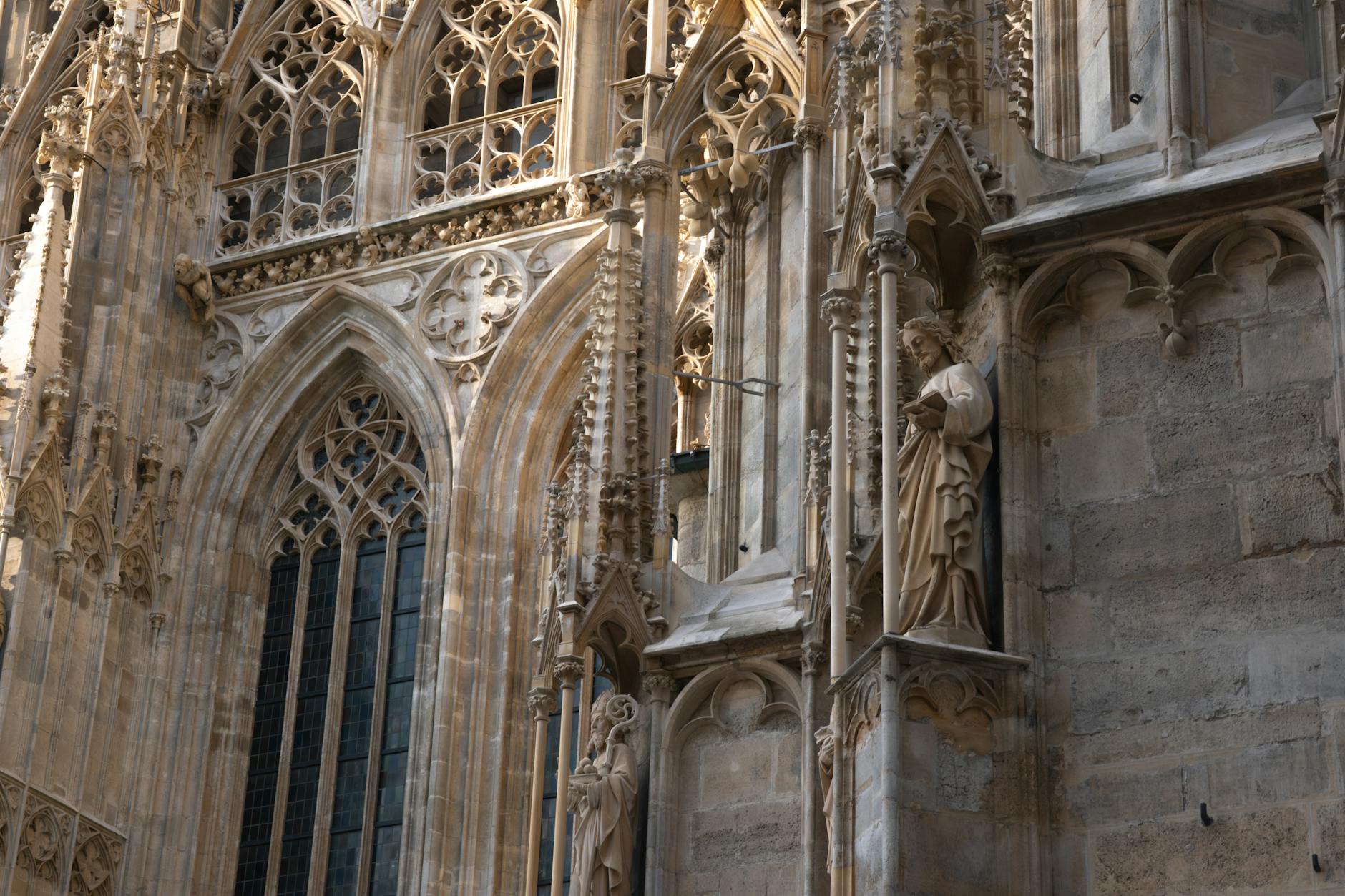
The Babenbergs built the first version of the Hofburg, expanded the city walls, and established Vienna as a cultural center. Their most enduring architectural legacy is St. Stephen’s Cathedral (Stephansdom), begun in Romanesque style in 1137 and dramatically expanded in Gothic style from the mid-14th century onward. The south tower (Steffl), completed in 1433, rises 136 meters and remained the tallest structure in Vienna for centuries — a visible symbol of the city’s growing wealth and ambition.
In 1278, Rudolf I of Habsburg defeated the last Babenberg heir and seized control of Austria, beginning the Habsburg dynasty’s 640-year rule of Vienna — one of the longest continuous reigns by a single family in European history. The Habsburgs would transform Vienna from a regional capital into the nerve center of a vast multinational empire stretching from the Adriatic to Galicia, from Bohemia to the Balkans.
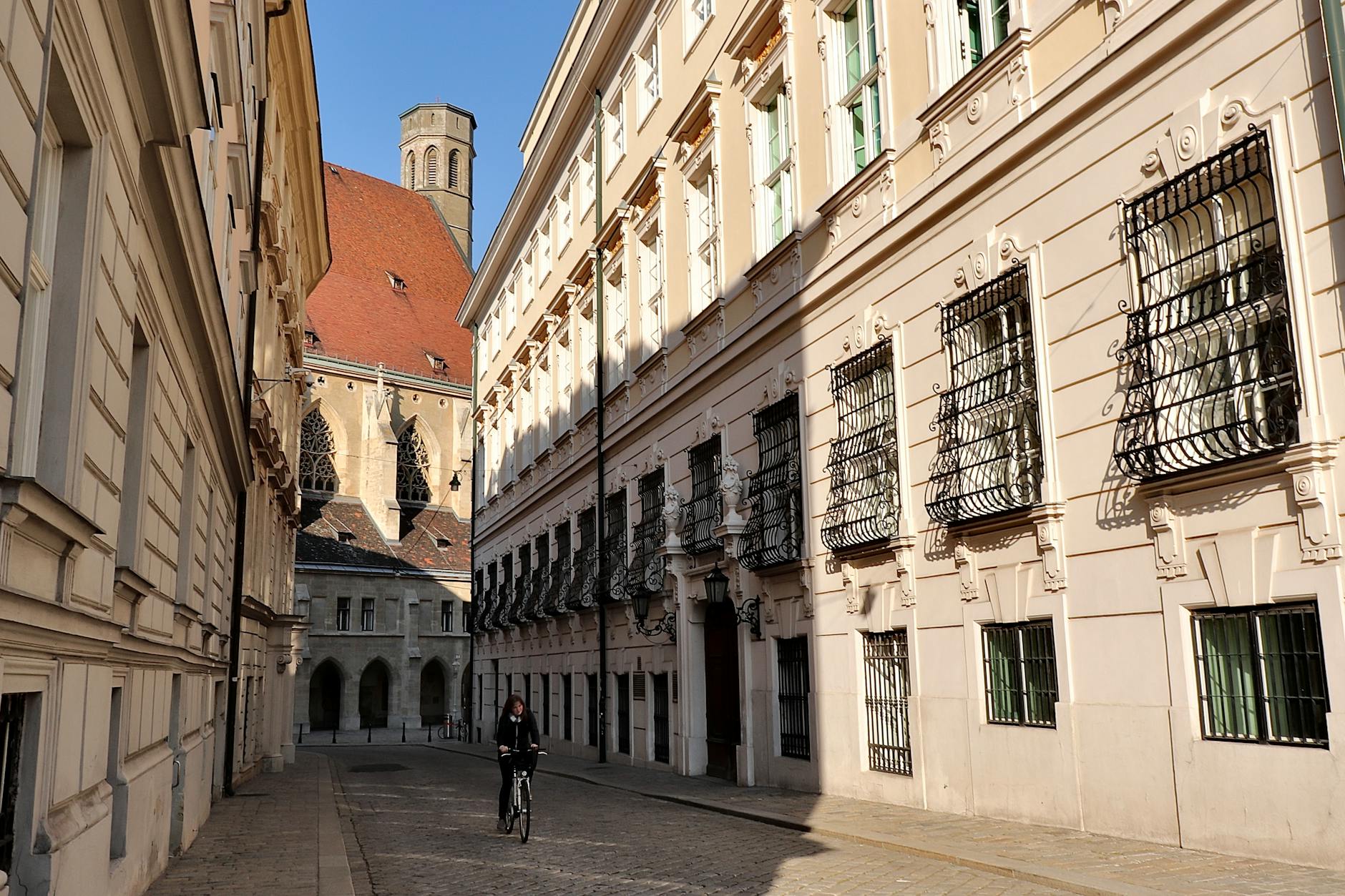
Medieval Vienna is still visible in the winding lanes of the Innere Stadt. Blutgasse (Blood Lane), Schönlaterngasse (Beautiful Lantern Lane), and the narrow passages around Fleischmarkt retain their medieval character. The oldest surviving secular building, the Deutschordenskirche (Church of the Teutonic Order), dates from the 14th century and houses a small museum of Crusader-era artifacts.
The Habsburgs consolidated power through a combination of strategic marriages (“Let others wage wars; you, happy Austria, marry!”) and military force. Rudolf IV “the Founder” (1339–1365) was particularly important for Vienna: he laid the foundation stone for the Gothic nave of St. Stephen’s Cathedral, established the University of Vienna in 1365 (making it one of the oldest German-speaking universities), and forged documents to elevate Austria’s status among the empire’s territories — the so-called Privilegium Maius, one of history’s most consequential forgeries.
By the 15th century, Vienna had become a fortified city of approximately 20,000 inhabitants, enclosed by walls punctuated by towers and gates. The Hoher Markt served as the main marketplace and execution site. The Jewish quarter, centered on what is now Judenplatz, was one of the largest in Central Europe until the brutal Vienna Gesera of 1420–21, when Duke Albrecht V ordered the persecution and expulsion of the entire Jewish community — a tragedy commemorated today by Rachel Whiteread’s haunting Holocaust Memorial on Judenplatz and the excavated ruins of the medieval synagogue beneath the square.
The Ottoman Sieges: Vienna Saves Europe (1529 and 1683)
Two events transformed Vienna from a prosperous city into a symbol of European resistance — and both left lasting marks on its architecture and identity. In 1529, Sultan Suleiman the Magnificent marched an Ottoman army of over 100,000 troops to the gates of Vienna. The city’s garrison of just 21,000 defenders, led by Niklas Graf Salm, held out through a desperate three-week siege before the Ottomans withdrew as winter approached. The siege failed, but it traumatized Vienna and led to massive investment in modern fortifications — the star-shaped bastions that would define the city’s footprint for the next three centuries.
The 1683 siege was even more dramatic. Grand Vizier Kara Mustafa laid siege to Vienna with an army of approximately 150,000. For two months, the city endured bombardment and mining operations that nearly breached the walls. Relief came on September 12, 1683, when a combined force of Austrian, Polish, and German troops under Polish King Jan III Sobieski launched one of the largest cavalry charges in history from the slopes of Kahlenberg, routing the Ottoman army. The Battle of Vienna is widely regarded as the turning point that ended Ottoman expansion into Central Europe.
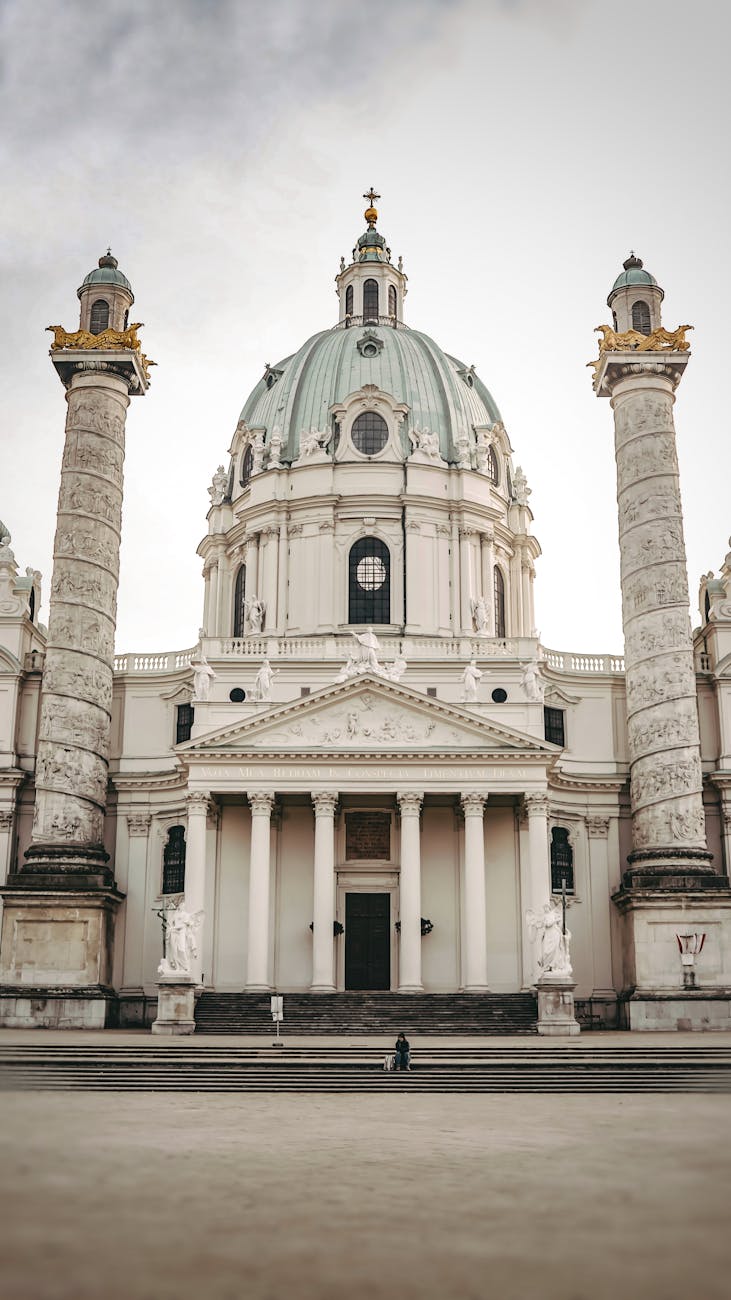
The psychological impact was enormous. Vienna celebrated its deliverance with an explosion of baroque architecture — triumphalist churches, palaces, and monuments that proclaimed Habsburg power and Catholic victory. The Karlskirche, built in the 1730s with twin columns modeled on Trajan’s Column in Rome, and the Pestsäule (Plague Column) on Graben are direct products of this post-siege cultural confidence.
Baroque Vienna: Imperial Splendor (17th–18th Century)
The century following the 1683 siege was Vienna’s golden age of architecture. Flush with confidence and enriched by expanding territories, the Habsburgs and Vienna’s nobility commissioned an astonishing building program that transformed the city into one of the most beautiful in Europe. Three architects dominated this era: Johann Bernhard Fischer von Erlach, Johann Lucas von Hildebrandt, and Jakob Prandtauer.
Fischer von Erlach designed Schönbrunn Palace (begun 1696), originally conceived as a Versailles-rivaling super-palace before being scaled back to the merely magnificent 1,441-room residence that stands today. He also created the Karlskirche and the Winterreitschule (Winter Riding School) at the Hofburg. Hildebrandt built the Belvedere Palace complex for Prince Eugene of Savoy — the military hero of the 1683 relief — as well as numerous aristocratic palaces (Palais Kinsky, Palais Daun-Kinsky) that line Vienna’s inner streets.
Under Empress Maria Theresa (reigned 1740–1780), baroque gave way to Rococo, and Schönbrunn received its famous yellow-painted façade and lavish interior decorations. Maria Theresa was arguably Vienna’s greatest builder-empress: she commissioned the renovation of the Hofburg, expanded the university, and established institutions that still operate today. Her reforms modernized Austria’s administration, education, and military — transforming a feudal empire into a more centralized state.
The baroque period also produced Vienna’s extraordinary church interiors. The Jesuitenkirche (Jesuit Church) on Dr.-Ignaz-Seipel-Platz features trompe-l’oeil ceiling frescoes by Andrea Pozzo that create the illusion of a soaring dome where none exists — a masterpiece of baroque illusionism. Peterskirche on Petersplatz packs an impossibly rich interior into a compact oval space. Together, Vienna’s baroque churches represent one of the finest collections of the style anywhere in the world.
The Belvedere Palace complex deserves special attention as the masterwork of the post-siege era. Built between 1714 and 1723 for Prince Eugene of Savoy — the brilliant military commander who helped lift the 1683 siege and went on to defeat the Ottomans across the Balkans — the Belvedere was both a summer residence and a statement of power rivaling the emperor’s own. Hildebrandt designed the Upper Belvedere’s garden façade as a cascade of sculptural elements, with roof pavilions inspired by Ottoman tents — a deliberate architectural trophy that incorporated the very forms of the enemy Eugene had defeated.
The baroque period also saw the transformation of Vienna’s streetscape through the construction of aristocratic Stadtpalais (city palaces). The Palais Liechtenstein, Palais Lobkowitz (where Beethoven premiered his Third Symphony), Palais Schwarzenberg, and dozens of others filled the streets between the Hofburg and the city walls with façades of extraordinary richness. Many now serve as museums, embassies, or hotels, but their exteriors remain largely unchanged — walking through the Innere Stadt’s streets is essentially walking through the largest preserved collection of baroque urban architecture in the world.
Vienna’s cultural life during this period was equally magnificent. Joseph Haydn served as the Esterházy court composer while spending significant time in Vienna. Wolfgang Amadeus Mozart arrived in 1781 and spent the most productive decade of his life here, premiering “The Abduction from the Seraglio,” “The Marriage of Figaro,” “Don Giovanni,” and “Così fan tutte” — operas that would define the art form. Mozart died in Vienna in 1791, aged 35, and was buried in an unmarked grave at St. Marx Cemetery (a memorial marks the approximate location). Ludwig van Beethoven moved to Vienna in 1792 and remained until his death in 1827, composing most of his major works in the city. These three composers alone would make Vienna the most important city in the history of Western music.
The Ringstraße Revolution (1857–1913)
In 1857, Emperor Franz Joseph issued a decree that would change Vienna forever: the medieval fortifications and the open glacis (killing ground) surrounding them would be demolished and replaced with a grand circular boulevard. The Ringstraße (Ring Road) project was the most ambitious urban planning initiative in 19th-century Europe — a 5.3-kilometer loop of monumental public buildings, parks, and apartment blocks that transformed Vienna from a cramped fortress city into a modern imperial showpiece.
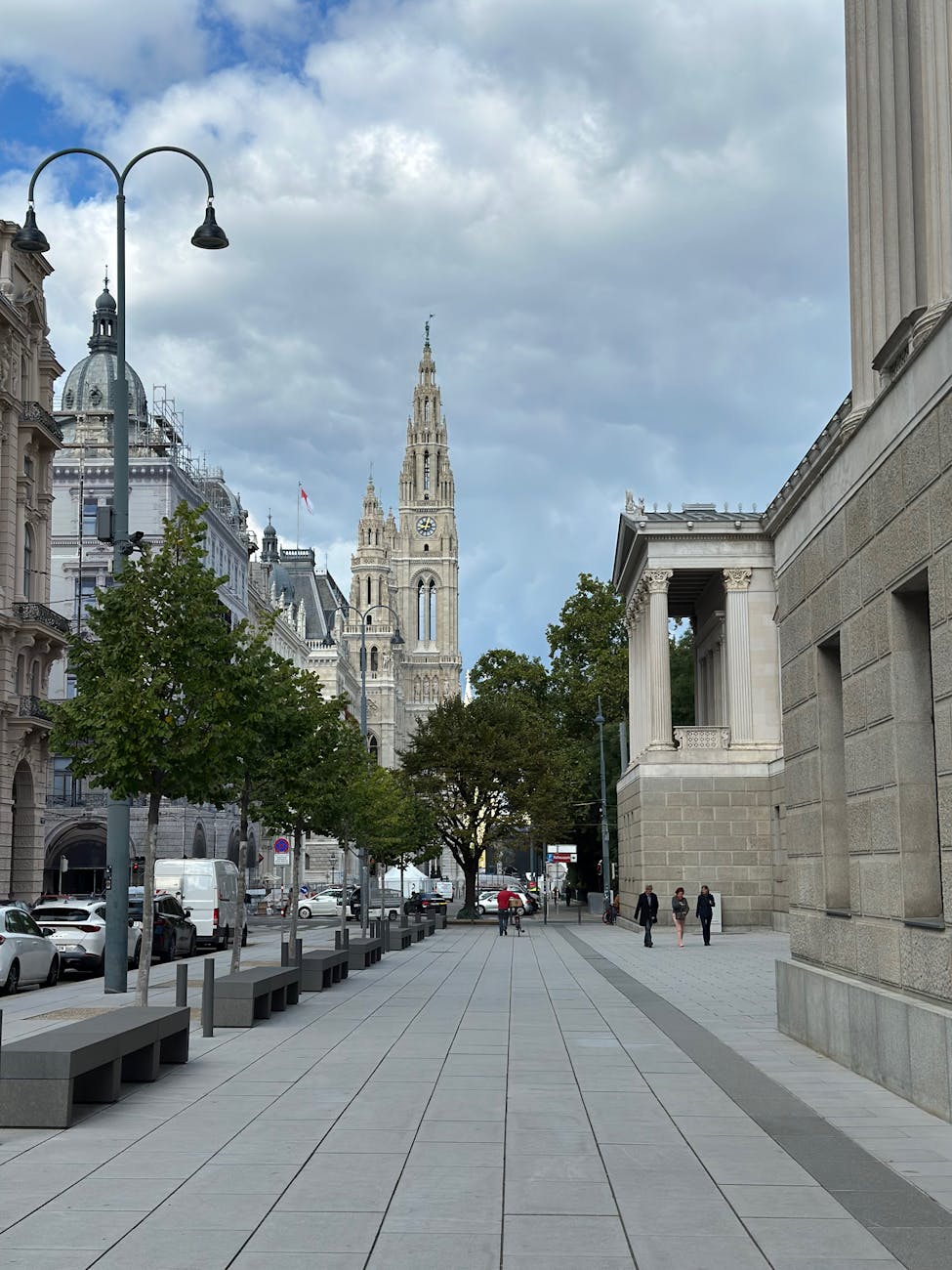
The buildings along the Ring deliberately showcased different historical styles — a movement called Historicism — with each building’s style chosen to symbolize its function. The Parliament (Theophil von Hansen, 1883) adopted Greek Revival, linking Austrian democracy to Athenian ideals. The Rathaus (City Hall, Friedrich von Schmidt, 1883) used neo-Gothic to evoke the freedom of medieval Flemish cities. The Burgtheater (Gottfried Semper and Karl von Hasenauer, 1888) employed neo-Baroque. The Vienna State Opera (August Sicard von Sicardsburg and Eduard van der Nüll, 1869) and the twin Kunsthistorisches and Naturhistorisches Museums (Semper and Hasenauer, 1891) rounded out the ensemble in neo-Renaissance style.
Walking the Ringstraße today is like attending a masterclass in 19th-century architectural theory. Every building is a deliberate statement about the relationship between form, function, and historical memory. The Votivkirche (Heinrich von Ferstel, 1879), built to celebrate Franz Joseph’s survival of an assassination attempt, rises in pure French Gothic — the most ornately detailed church on the Ring and perhaps the finest neo-Gothic building in Central Europe.
The Ringstraße wasn’t just an architectural project — it reshaped Viennese society. The grand apartment buildings lining the boulevard attracted the city’s wealthy bourgeoisie, who aspired to live in settings as grand as the aristocracy. These Ringstraßen-Palais apartments featured elaborate stucco ceilings, parquet floors, and salon-sized rooms designed for entertaining. The social life that developed around the Ring — the promenading, the café culture, the theater-going — created the distinctive Viennese blend of sophistication and performance that persists today.
This era also produced what historian Carl Schorske called “Fin-de-Siècle Vienna” — one of the most extraordinary concentrations of intellectual and creative talent in history. At the same time as the Ringstraße was being completed, Sigmund Freud was developing psychoanalysis at Berggasse 19, Ludwig Wittgenstein was reinventing philosophy, Gustav Mahler was directing the Court Opera, Arthur Schnitzler was shocking audiences with sexually frank theater, and Egon Schiele and Oskar Kokoschka were pushing Expressionism into visceral new territory. This intellectual ferment was deeply connected to the architecture — the tension between Historicist tradition and radical innovation played out simultaneously in buildings, painting, music, psychology, and literature.
Vienna Secession and Jugendstil (1897–1914)
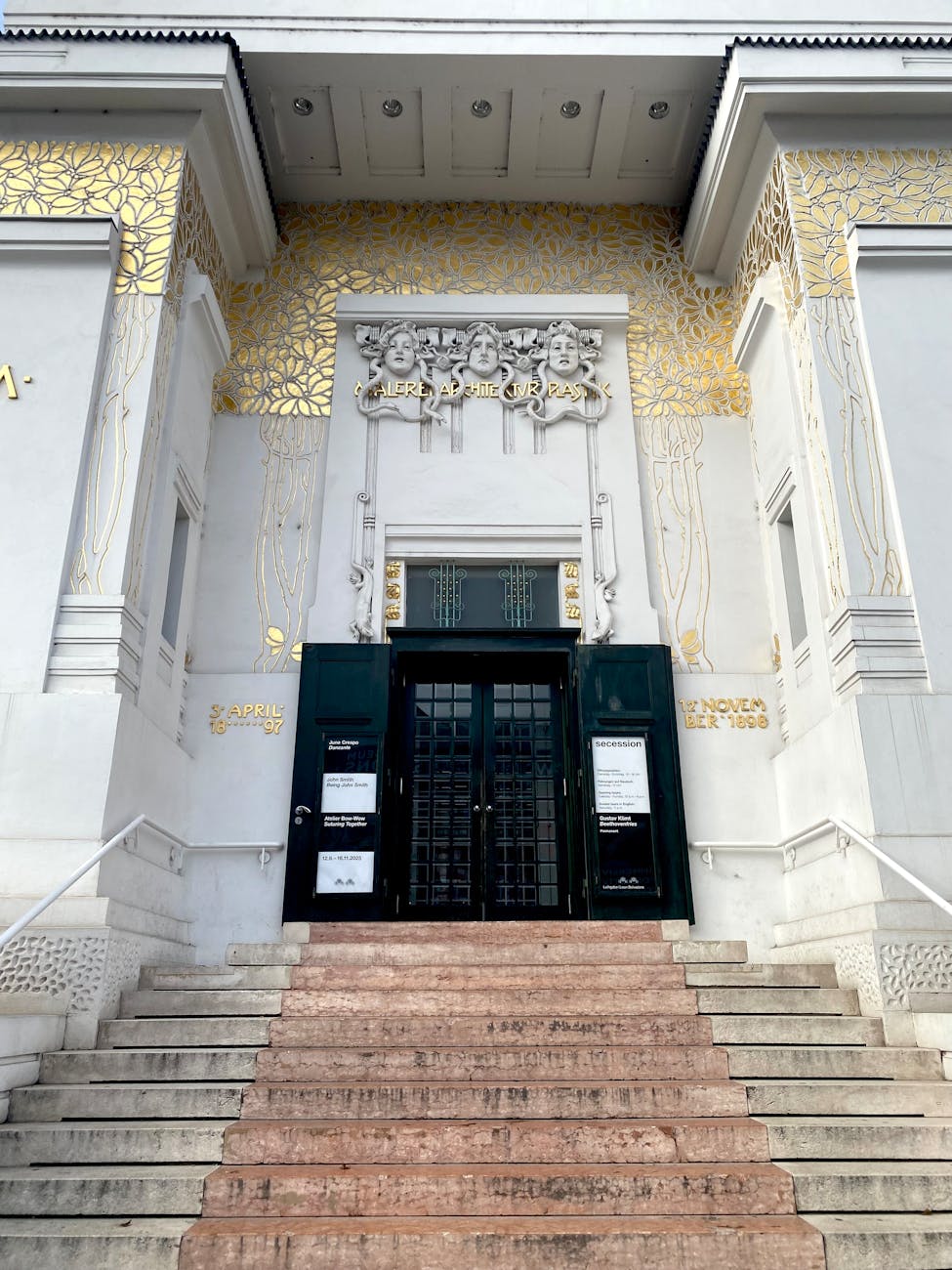
By the 1890s, a generation of young Viennese artists and architects had grown restless with the Ringstraße’s backward-looking Historicism. In 1897, Gustav Klimt, Josef Hoffmann, Koloman Moser, and others broke away from the conservative Künstlerhaus association to form the Vienna Secession — a movement dedicated to creating art and architecture free from historical imitation. Their motto, inscribed in gold above the Secession Building’s entrance, declared: “Der Zeit ihre Kunst, der Kunst ihre Freiheit” (To every age its art, to art its freedom).
The Secession Building itself (Joseph Maria Olbrich, 1898) was a manifesto in stone — a stark white cube topped with a filigree dome of 3,000 gilded laurel leaves (the “golden cabbage”). Inside, Klimt’s monumental Beethoven Frieze stretched 34 meters across three walls, fusing symbolism, eroticism, and musical inspiration in a work that scandalized Vienna and changed the direction of modern art.
The architectural giant of the period was Otto Wagner, who evolved from a respected Historicist architect into the father of Viennese modernism. His Stadtbahn stations (1894–1901) along the U4 and U6 lines — particularly the elegant Karlsplatz pavilions with their sunflower motifs and green copper roofs — brought Art Nouveau to everyday Viennese life. Wagner’s Postsparkasse (Postal Savings Bank, 1912) on Georg-Coch-Platz is considered a masterpiece of proto-modernism: the aluminum-bolted marble façade and the luminous, functionally designed banking hall anticipated the Bauhaus by a decade.
Wagner’s student Joseph Maria Olbrich designed the Secession Building, while another protégé, Josef Hoffmann, co-founded the Wiener Werkstätte (Vienna Workshop), applying Secessionist principles to furniture, textiles, jewelry, and everyday objects — creating a total design philosophy that influenced everything from art deco to Scandinavian modernism.
Meanwhile, Adolf Loos took Viennese modernism in a radically different direction. His Looshaus (1911) on Michaelerplatz — directly facing the ornate Hofburg — provoked outrage with its stark, unornamented façade. Emperor Franz Joseph reportedly refused to use the Hofburg entrance facing the building. Loos’s 1908 essay “Ornament and Crime” argued that decoration was a waste of resources and a sign of cultural regression — ideas that would profoundly influence Le Corbusier, Mies van der Rohe, and the entire modernist movement.
War, Destruction, and Rebirth (1914–1955)
World War I ended the Habsburg Empire and shrank Austria from a multinational superpower of 52 million people to a small Alpine republic of 6.5 million. Vienna, designed as the capital of a vast empire, was suddenly an oversized head on a diminished body. The interwar period brought political instability, economic crisis, and the remarkable experiment of “Red Vienna” (1919–1934), when the Social Democratic city government built over 60,000 public housing units — including the enormous Karl-Marx-Hof (1930), a 1.2-kilometer-long housing complex in Heiligenstadt that remains the longest residential building in the world and a masterpiece of social housing architecture.
The Anschluss of March 1938 brought Austria into Nazi Germany, and Vienna’s Jewish community — which had contributed enormously to the city’s intellectual and cultural life (Freud, Mahler, Wittgenstein, Schiele, and hundreds of thousands of others) — was systematically persecuted and destroyed. Of approximately 200,000 Viennese Jews, around 65,000 were murdered in the Holocaust, and most of the rest fled into exile. The cultural devastation was incalculable.
Allied bombing during 1944–1945 destroyed or damaged approximately 20% of Vienna’s buildings, including significant damage to the State Opera, St. Stephen’s Cathedral (whose roof collapsed in the fires of April 1945), and numerous historic structures. The Soviet capture of Vienna in April 1945 brought further destruction, followed by a decade of four-power Allied occupation (American, British, French, and Soviet zones — famously depicted in the 1949 film “The Third Man”).
Vienna’s reconstruction was remarkably faithful. The State Opera reopened in 1955 with the original façade meticulously restored. St. Stephen’s Cathedral was rebuilt with contributions from all nine Austrian provinces — each donating specific elements (the great bell “Pummerin” was recast from the metal of Turkish cannons captured in 1683, maintaining the historical symbolism even in the act of reconstruction).
The post-war occupation era (1945–1955) left its own subtle architectural mark. Vienna was divided into four sectors, with the Innere Stadt declared an international zone administered jointly by all four powers. The monthly rotation of sector control meant that Soviet, American, British, and French military police patrolled together — a peculiar arrangement that Graham Greene immortalized in “The Third Man.” The Soviet War Memorial on Schwarzenbergplatz (which Viennese sometimes irreverently call “the unknown plunderer”) remains from this period — a grand colonnade topped by a Soviet soldier that Austria is treaty-bound to maintain in perpetuity.
Austria’s State Treaty of 1955, which ended the occupation and established Austrian neutrality, was signed in the Upper Belvedere — the same building where the Austrian Republic had been proclaimed in 1918. The famous photograph of Foreign Minister Leopold Figl holding the signed treaty aloft on the Belvedere’s balcony is one of the most iconic images in Austrian history. Austria joined the United Nations the same year and established itself as a neutral meeting ground between East and West — a role symbolized by the Vienna International Centre (UNO City), built in the 1970s on the Danube’s left bank.
Modern and Contemporary Architecture
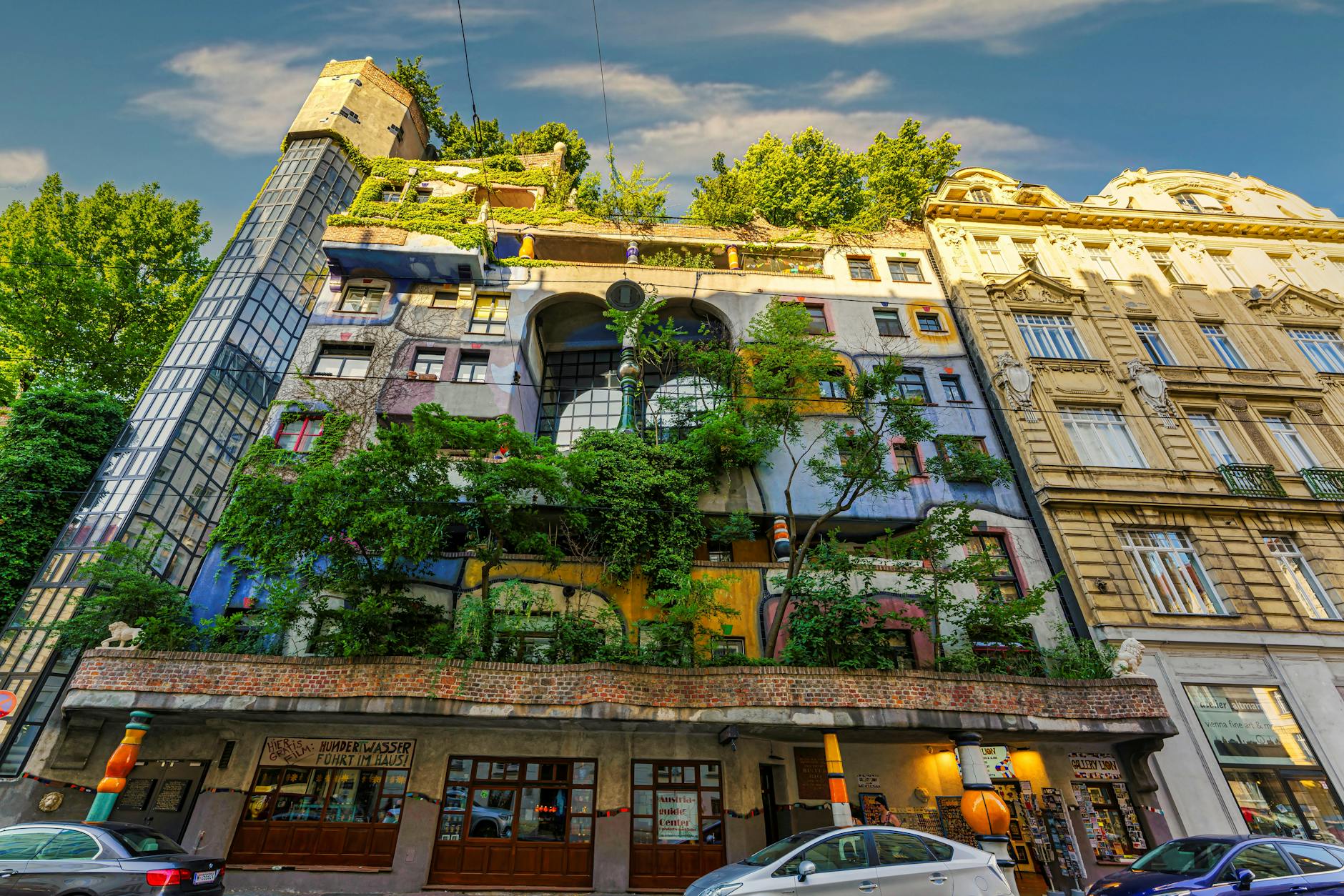
Post-war Vienna was slow to embrace contemporary architecture — the trauma of destruction made conservation a priority, and the city’s extraordinary historical fabric left little appetite for modernist experiments. The first major break came from an unlikely source: the painter Friedensreich Hundertwasser, whose Hundertwasserhaus (1985) in the 3rd district rejected straight lines and right angles in favor of undulating floors, irregular windows, and trees growing from balconies and rooftops. Controversial upon completion, it became one of Vienna’s most-visited buildings and proved that the city’s appetite for architectural experimentation hadn’t disappeared — it had merely been sleeping.
The 1990s and 2000s brought Vienna firmly into the contemporary architectural conversation. The MuseumsQuartier (2001) transformed the former Imperial Stables into one of the world’s largest cultural complexes, inserting bold modernist galleries by Ortner & Ortner into the historic baroque shell. The Gasometers project (2001) converted four enormous 19th-century gas storage tanks in Simmering into mixed-use residential and commercial complexes, with interiors designed by Jean Nouvel, Coop Himmelb(l)au, Manfred Wehdorn, and Wilhelm Holzbauer — a brilliant example of adaptive reuse.
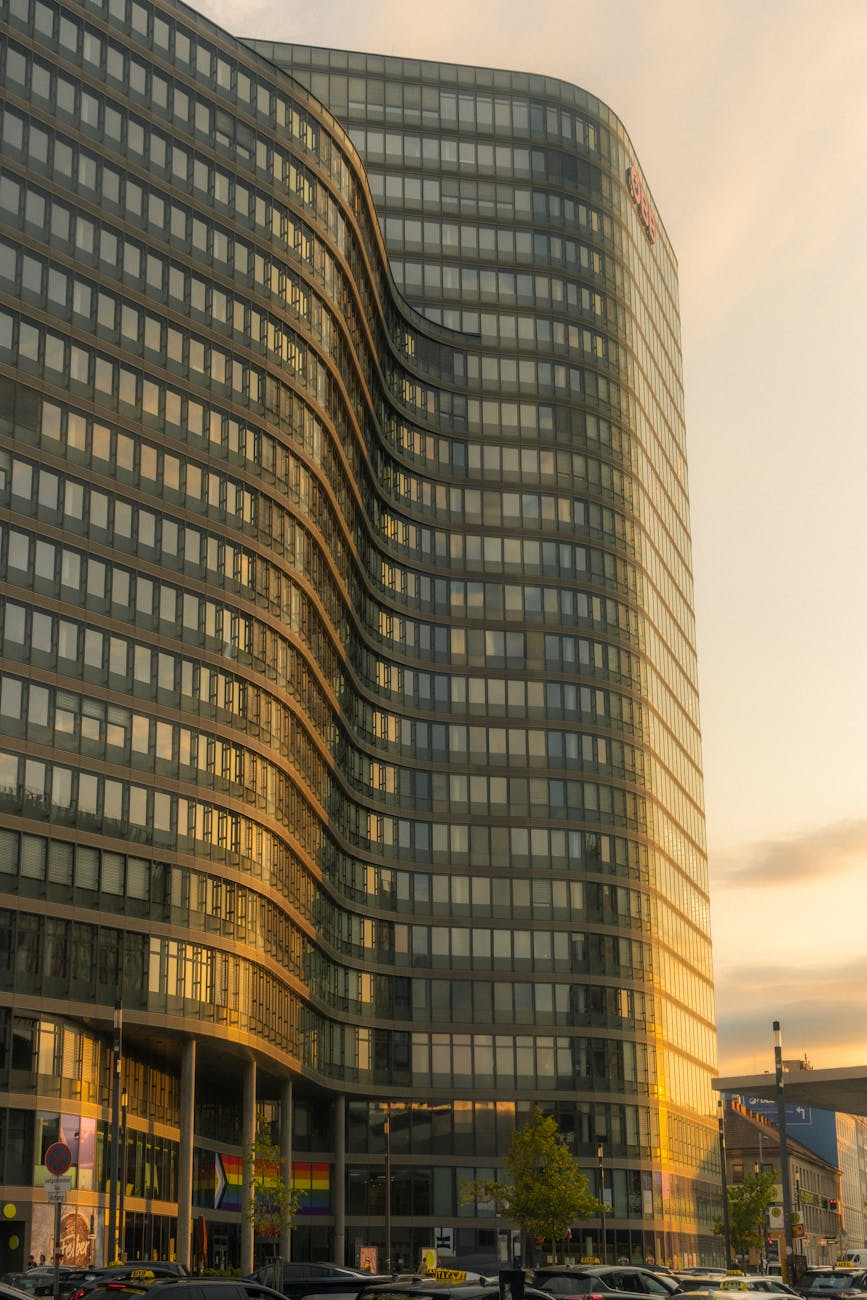
The DC Tower 1 (Dominique Perrault, 2014) in the Donau City business district rises 250 meters — Vienna’s tallest building — with a distinctive angular glass façade that catches light differently throughout the day. Nearby, the Vienna International Centre (1979) houses the United Nations Office at Vienna, symbolizing Austria’s post-war role as a neutral meeting point between East and West.
Perhaps the most architecturally significant recent addition is the Campus of the Vienna University of Economics and Business (WU Wien, 2013), where six buildings by different international architects — including Zaha Hadid’s Library and Learning Center with its dramatic cantilevered form — create a mini-city of contemporary design in the 2nd district. The campus is free to visit and represents Vienna’s most concentrated collection of 21st-century architecture.
Another striking example of Vienna’s architectural confidence is the Haas-Haus (Hans Hollein, 1990) on Stephansplatz — a curved glass-and-stone commercial building that directly faces St. Stephen’s Cathedral. The juxtaposition was intentionally provocative: Hollein’s reflective glass façade literally mirrors the Gothic cathedral, creating a visual dialogue between medieval and postmodern that perfectly captures Vienna’s relationship with its past. Controversial at first, the Haas-Haus is now accepted as a landmark in its own right and represents Vienna’s willingness to engage in architectural conversations that other cities might avoid.
The Spittelau waste incineration plant (redesigned by Hundertwasser in 1989–1997) turns industrial infrastructure into public art — its golden dome, colorful ceramic tiles, and planted rooftops make it one of Vienna’s most photographed buildings and a model for how cities can make essential utilities beautiful. Similarly, the Zentralfriedhof (Central Cemetery), while not a building per se, contains extraordinary architecture spanning from Karl Lueger’s Art Nouveau church by Max Hegele to the modernist crematorium — a reminder that Viennese architectural ambition extends even to how the city honors its dead.
Where to See Vienna’s History: A Walking Guide
Walk 1 — 2,000 Years in 2 Hours: Start at the Römermuseum on Hoher Markt (Roman origins), walk to St. Stephen’s Cathedral (Gothic/medieval), continue to Graben and the Pestsäule (baroque), turn down Kohlmarkt to Michaelerplatz (see the Looshaus confronting the Hofburg — Historicism vs. Modernism in a single glance), enter the Hofburg complex (Habsburg power), exit to the Ringstraße (19th-century urban vision), and finish at the Secession Building (Jugendstil revolution).
Walk 2 — Ringstraße Architecture Tour: Take Tram 1 or 2 around the full Ring, hopping off at the Opera (neo-Renaissance), Parliament (Greek Revival), Rathaus (neo-Gothic), Burgtheater (neo-Baroque), University (neo-Renaissance), and Votivkirche (neo-Gothic). The full circuit covers 5.3 kilometers and can be walked in 90 minutes or ridden by tram in 25 minutes.
Walk 3 — Otto Wagner and Jugendstil: Start at the Wagner Pavilions on Karlsplatz (U4), visit the Secession Building, walk along the Linke Wienzeile to see the Majolika House and Medallion House (Wagner’s ornamental apartment buildings), then take the U4 to Hietzing to see the Wagner Villa and Kirche am Steinhof (book ahead — limited visiting hours). End at Schönbrunn to compare Wagner’s modern aesthetic with Habsburg baroque.
Frequently Asked Questions
How old is Vienna?
Vienna has been continuously inhabited for over 2,000 years. The Roman military camp Vindobona was established around 15 BC. The name “Wenia” (from which Wien/Vienna derives) first appears in written records in 881 AD.
Why is Vienna called the “City of Music”?
More great composers lived and worked in Vienna than in any other city: Mozart, Beethoven, Schubert, Brahms, Strauss, Mahler, Schoenberg, and Berg all called Vienna home. The city’s musical institutions — the Vienna Philharmonic, the State Opera, the Musikverein — have operated continuously for centuries, creating an unbroken tradition of musical excellence.
What happened to Vienna in World War II?
Vienna suffered 52 Allied bombing raids between 1944 and 1945, which destroyed or damaged roughly 20% of the city’s buildings. The Soviet army captured Vienna in April 1945 after fierce urban fighting. The city was then divided into four occupation zones (American, British, French, Soviet) until the Austrian State Treaty of 1955 restored full sovereignty.
Is Vienna’s historic center a UNESCO World Heritage Site?
Yes, the Historic Centre of Vienna was inscribed as a UNESCO World Heritage Site in 2001, recognizing the extraordinary ensemble of baroque palaces, Ringstraße-era buildings, and medieval streetscapes in the Innere Stadt. However, it was placed on the “in danger” list in 2017 due to concerns about high-rise development near the Wien Mitte area — a controversy that reflects the ongoing tension between preservation and modernization.
What are the best buildings to see in Vienna?
For a comprehensive architectural experience: Schönbrunn Palace (baroque/Rococo), St. Stephen’s Cathedral (Gothic), Hofburg (multiple periods), the Ringstraße buildings (Historicism), the Secession Building and Postsparkasse (Jugendstil/early Modern), Karl-Marx-Hof (social housing), Hundertwasserhaus (postmodern), and WU Campus/DC Tower (contemporary).
What is the most important building in Vienna?
This is debated, but most architectural historians would say St. Stephen’s Cathedral — it has been the spiritual center of the city for nearly 900 years and survived sieges, fires, and bombings. For political significance, the Hofburg edges ahead as the seat of Habsburg power for over six centuries. For architectural innovation, Otto Wagner’s Postsparkasse is often cited as the building that changed the direction of European architecture.
Can I visit Vienna’s historic buildings for free?
Many of Vienna’s most important buildings are freely viewable from the outside, and several interiors are free to enter. St. Stephen’s Cathedral (nave), the Peterskirche, the Augustinerkirche, the Votivkirche, and the Jesuitenkirche are all free. The Schönbrunn and Belvedere gardens are free, as is the Ringstraße itself — the world’s greatest open-air architectural museum. Several municipal museums, including those with Roman and medieval exhibits, are free on the first Sunday of each month.
A Brief Vienna History Timeline
c. 15 BC — Romans establish Vindobona military camp. 881 AD — First written mention of “Wenia.” 1137 — Construction of St. Stephen’s Cathedral begins. 1156 — Vienna becomes capital of the Duchy of Austria under the Babenbergs. 1278 — Habsburgs take control of Austria. 1365 — University of Vienna founded. 1529 — First Ottoman siege. 1683 — Second Ottoman siege and Battle of Vienna. 1696 — Construction of Schönbrunn Palace begins. 1740–1780 — Reign of Empress Maria Theresa. 1857 — Franz Joseph orders demolition of city walls; Ringstraße construction begins. 1897 — Vienna Secession movement founded. 1918 — Habsburg Empire collapses; Austrian Republic proclaimed. 1938 — Anschluss with Nazi Germany. 1945 — Allied bombing and Soviet liberation. 1955 — Austrian State Treaty restores sovereignty. 2001 — Historic Centre inscribed as UNESCO World Heritage Site. 2013 — WU Campus (including Zaha Hadid Library) opens. 2014 — DC Tower 1 completed.
Vienna’s Story Continues
What makes Vienna extraordinary is not just the quantity of its historical architecture but the way every era coexists, often within a single streetscape. Stand on Michaelerplatz and you can see Roman excavations, medieval foundations, baroque facades, a 19th-century palace wing, and Adolf Loos’s proto-modernist provocation — all within a 50-meter radius. This layered quality is what UNESCO recognized and what makes Vienna’s architecture endlessly fascinating.
The city continues to build. New projects in the Aspern Seestadt development, the Nordbahnhof quarter, and the continued evolution of Donau City are adding contemporary chapters to a story that began with Roman legionaries on the Danube frontier. Vienna’s genius has always been its ability to absorb new influences while preserving what came before — and that tradition shows no sign of ending.
Continue exploring Vienna with our guides to planning your trip, 101 things to do, top attractions, opera and classical music, and where to eat.
Leave a Reply